
Stance
Typically, your basic stance will not change no matter which guard position you are in, and this makes for a far easier the simpler system than many other forms of swordsmanship. You should stand lead foot forward to your opponent (right foot for a right-hander, left for a left-hander). The front foot should point towards your opponent. Your left foot should be pointed off to the side at a roughly ninety-degree angle (experiment with this angle to see what suits you). You can have your heels inline as in the lower diagram below or spaced apart side to side as in the upper one. Your feet should be approximately shoulder width apart, front to back.
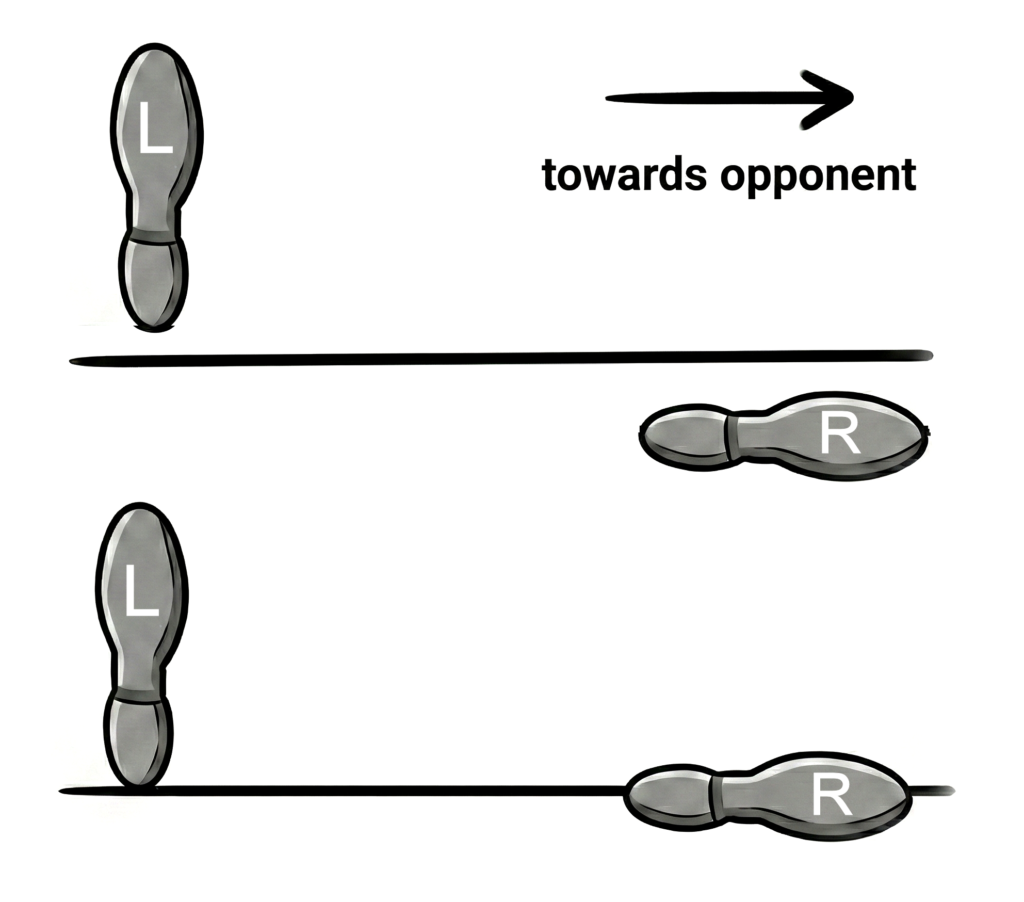

Body weighting is typically either rear weighted on the back foot, or centre weighted. This is to encourage defensive footwork and enable fast slips or shifts as described below. The left hand (for a right-hander) should be placed back near your chin as in smallsword, or on the hip. The latter is preferred because it keeps it safely out of the way from both your sword and your opponent’s.

Slip or Shift
A slip is to remove that part of your body which your opponent aims at so that they miss. A shift is the moving back of the lead foot, and so the shift is a type of slip, and either term can be used. This is a defensive piece of footwork not only intended to avoid leg attacks, but also to give you more time to parry, and make you safer against your opponent’s follow up attacks and deceptions. In Roworth this is a common defensive step used during many if not most parries, regardless of the target. You should practice this commonly during parries. You should only parry without using this step if you are very confident that your opponent is not going to target low openings.
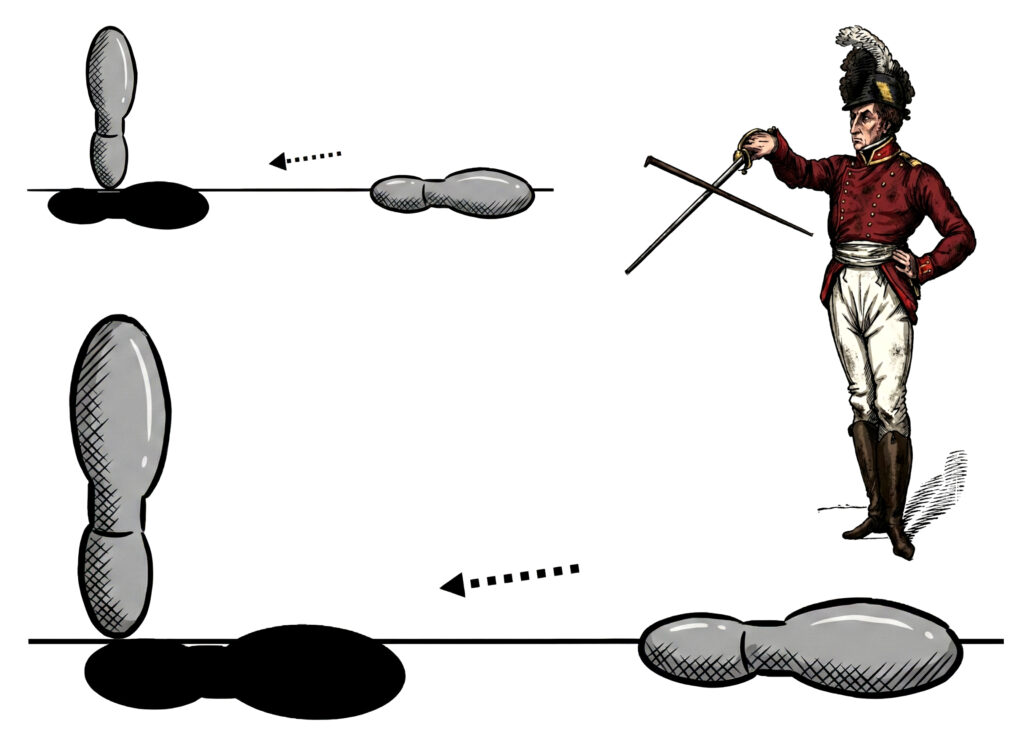
There is a variant of the shift from Mathewson where the lead foot is withdrawn further to the rear, and the toes touch the ground for stability behind you. Some people find this more comfortable and it is also had another advantage in that you can more quickly take another step backwards if your opponent is pressing you or they target your rear leg. The advantage and use of slipping the leg is shown in the illustrations below, from Roworth.

THE MATHEWSON SLIP OR SHIFT VARIANT

Lunge
The typical attacking step. Every attack is made with a lunge unless you are told otherwise. This is a step forward with the front foot whilst keeping the back foot in position. You then use the extension of the whole body to reach forward towards your opponent to strike them. Do not take too large a step, or reach excessively far forward, as you will be slow to recover and at risk of being struck.
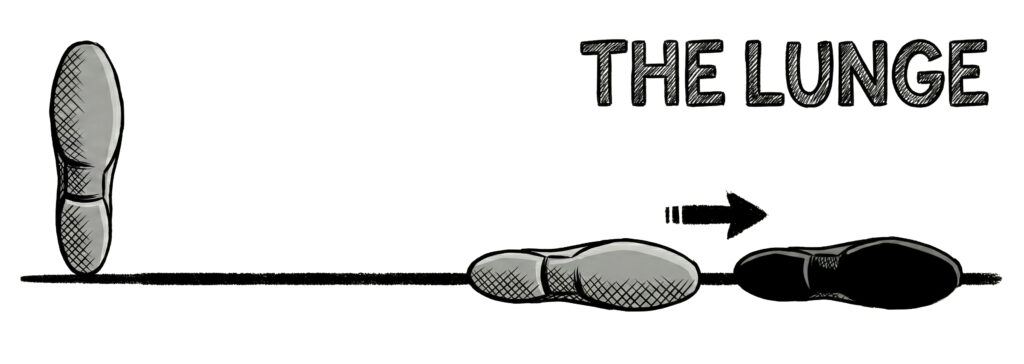
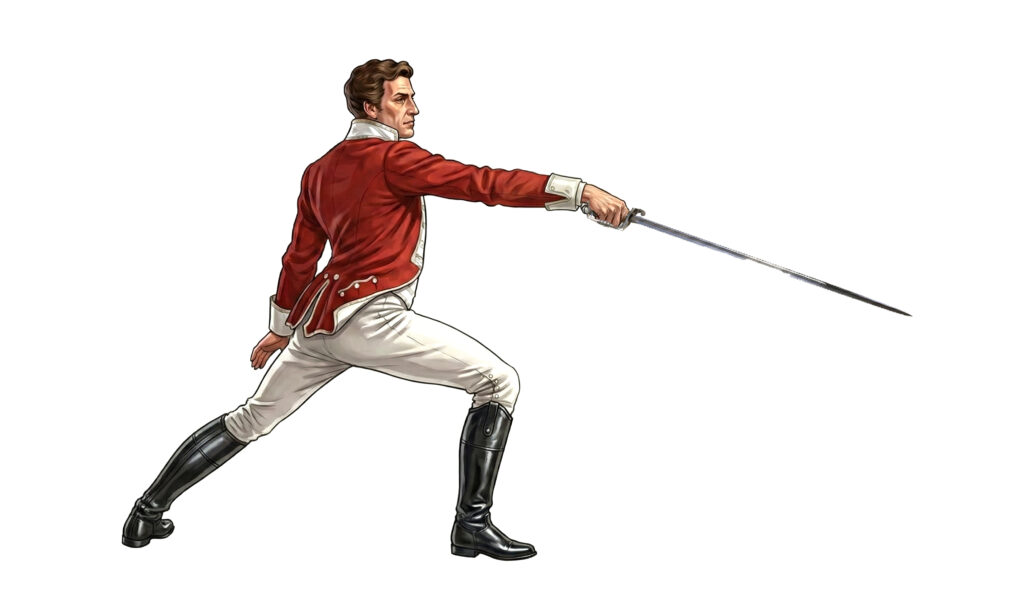
There are many bad habits which should be corrected, but the basics are here –
- Make sure your lead foot points towards the opponent
- Keep the back foot flat on the ground
- Straighten the back leg immediately as you lunge to power your movement
- Do not let the lead knee bend inwards, it should be over the top of your lead foot
- Drive your lead shoulder forward for reach
The lunge is executed by first moving the sword, and then the body and foot follow. Imagine someone is pulling the tip of your sword forward. This will ensure your sword covers you from your opponent whilst making your lunge. The left hand can be thrown back to help align the shoulders or kept on the hip as you find comfortable.
Advance & Retreat
These are your typical adjustment steps for changing distance with your opponent. When you want to move forward, step with the front foot and then bring up the rear one. When moving backwards, step with the rear foot and then bring up the front foot. Roworth’s manual has a more advanced version of the advance using multiple smaller steps, but this is easier as a beginner or typical version. Note that the lead foot stays in front. Stepping through with the rear foot is called a passing step, and we only do that during specific actions such as disarms. Keeping the lead foot forward ensures that your sword is kept well in front for your protection and maximum reach when striking.
